Why Agricultural Success is Decided Long Before the First Seed is Planted
We habitually misdiagnose agricultural failure. When a season ends in ruin, the industry reflexively blames the sky or the soil—erratic rains, exhausted nutrients, or the farmer’s technical shortcomings. But as an analyst of the supply chain, I see a far more cynical reality: many seasonal losses are predestined. For a staggering number of farmers, the game is rigged at the point of purchase, and the harvest is lost before the first seed ever touches the ground.
The labor and sweat of the growing season are often nothing more than a slow-motion reveal of a failure that was finalized months earlier. To understand why, we must look past the farm gate and into the systemic deceptions of the input market.
♦
The Visual Trap: Why Packaging is Cloned, Not Seeds
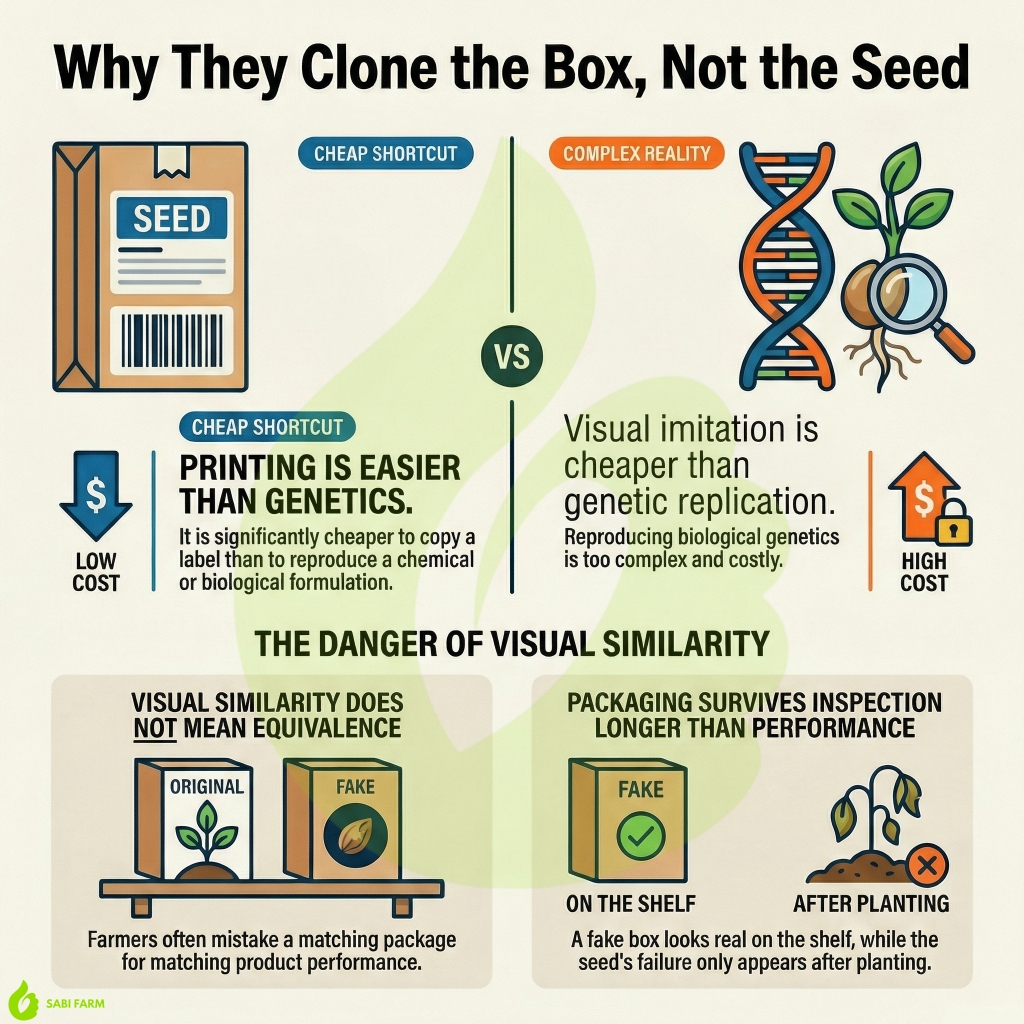
In the market for agricultural inputs, appearance is a cheap commodity, while performance is an expensive science. There is a recurring, dangerous pattern across the supply chain: it is infinitely easier to mimic the look of a premium product than its biological integrity.
Printed materials—labels, bags, and holographic stickers—are trivial to imitate compared to the complex genetics of a high-yield seed or the precise chemical formulation of a pesticide. This creates a visual trap where similarity is mistaken for equivalence. Because packaging survives physical inspection much longer than the input itself, the deception remains invisible until it is too late. The label stays intact on the shelf, while the biological truth only emerges weeks or months after the investment is sunk.
“It is easier and cheaper to copy packaging than to reproduce biological quality.”
♦
The Hidden Vulnerability of Informal Markets
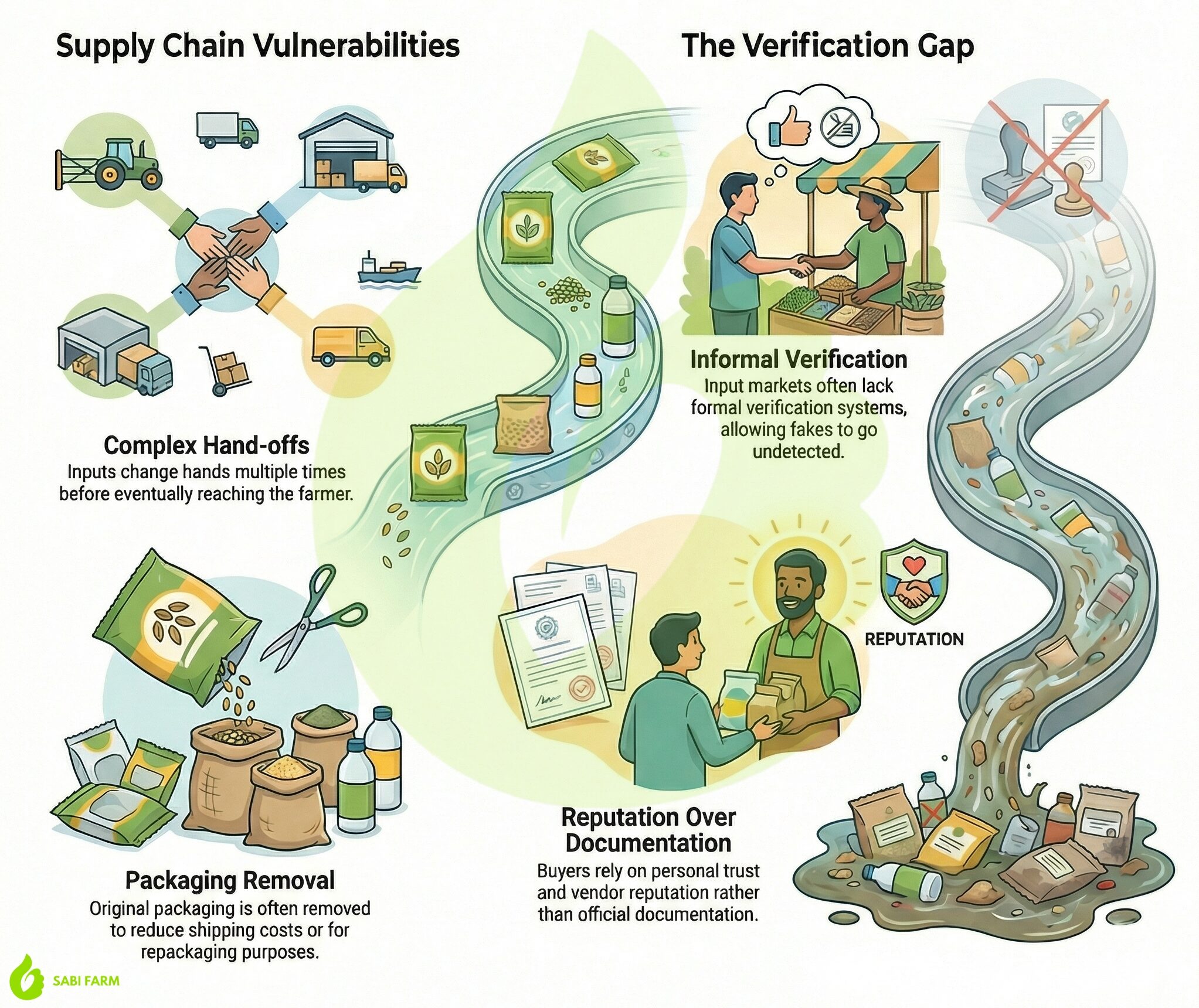
Fake inputs do not appear by accident; they thrive in the shadows of informal supply chains. As inputs move from manufacturers to distributors and finally to the farm, they change hands multiple times. At each link in this chain, the opportunity for exploitation grows.
The most critical point of failure is the removal of original packaging. Often framed as a way to “reduce cost” or “repackage” for smaller, more affordable sales, this act is, in reality, a destruction of evidence. Once the original container is discarded, the buyer loses their only proxy for truth. Because the industry lacks a robust infrastructure for verifiable data at the retail level, the market defaults to a system of “reputation” and “informal trust.” In this environment, even an honest middleman becomes a conduit for fraud, passing on fake inputs because they lack the tools to prove otherwise.
The Loss Before the Start
It is a counter-intuitive truth that a significant portion of agricultural loss is finalized at the moment of transaction. This is not merely a matter of bad luck, but a result of systemic misrepresentation and the critical lack of source information available to the buyer. When the link between the producer and the end-user is severed, failure becomes the default.
These pre-planting losses are driven by three primary factors:
- Wrong input for climate or season: Selling materials that are biologically ill-suited for the specific environment of the farm.
- Undeclared substitutions: The intentional replacement of high-quality inputs with inferior alternatives without informing the buyer.
- Lack of source information at the point of purchase: An inability to verify the origin or intended specifications of the product.
In these instances, the farmer isn’t just buying a product; they are buying a mismatch that ensures a sub-par yield regardless of how well they manage their land.
Restoring the Chain of Trust
The challenges facing modern agriculture go far deeper than the furrow. The deception of cloned packaging, the inherent risks of informal repackaging, and the intentional misrepresentation of inputs have created a landscape where failure is baked into the process.
As long as we rely on the visual “feeling” of a brand rather than the hard reality of its data, we will continue to see harvests fail. We must ask ourselves: How much longer can the agricultural industry survive on a system of blind visual trust before we demand the infrastructure for verifiable, ground-truth data? Until we can verify the seed, the harvest will remain a gamble that the farmer has already lost.